
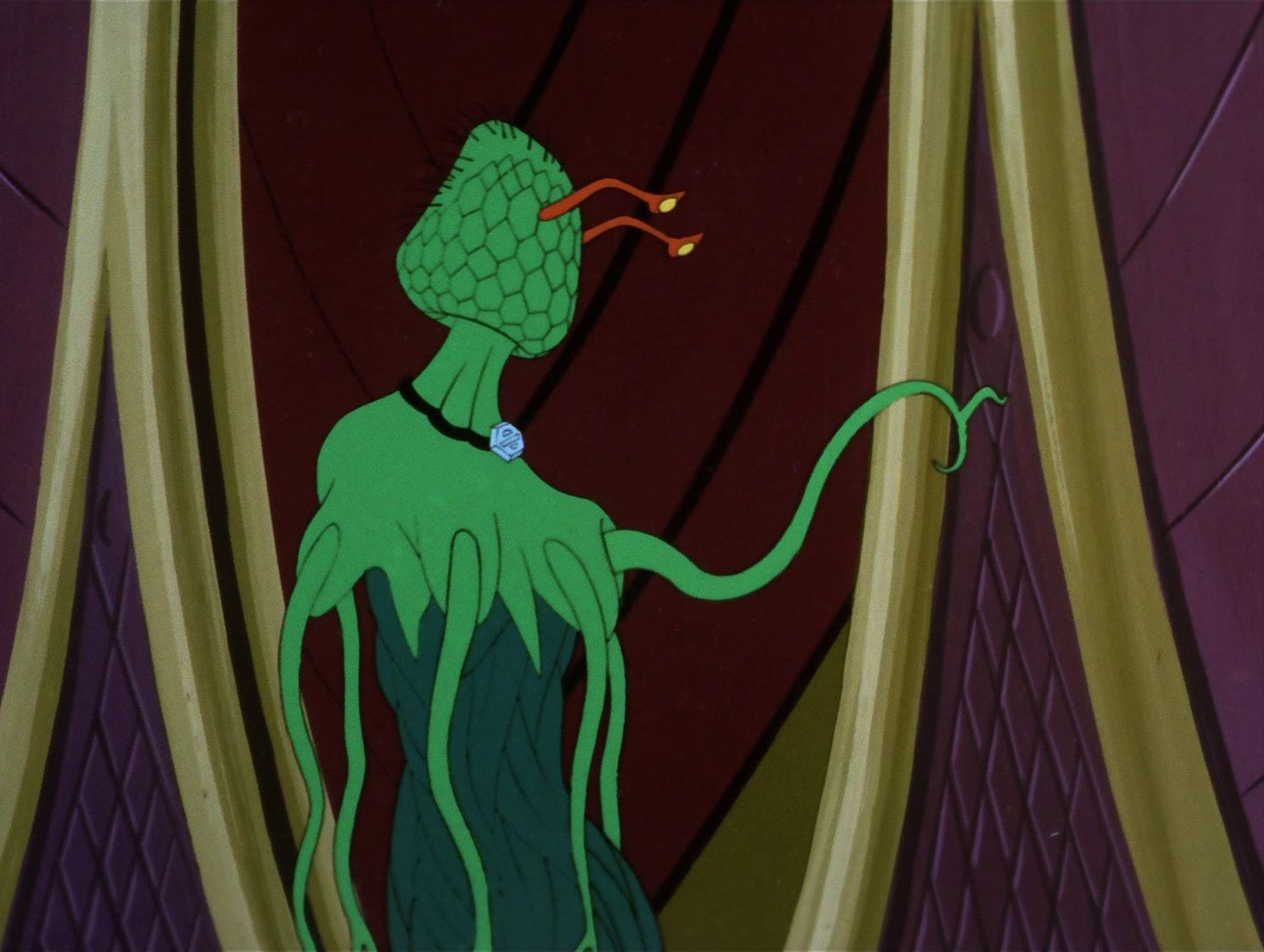
Plants rarely make an appearance in Sci-Fi shows, and even less so as walking, talking intelligent lifeforms. With the Animated Series’s increased ability to explore new alien designs, Kirk and crew were able to meet a civilization of four-legged plant beings. Hoping to colonize the planet Phylos for the Federation, the Enterprise crew stumble upon a struggling but highly sophisticated society of plant people. Lieutenant Sulu is bitten by a walking plant creature, and the native Phylosians are able to neutralize the toxin and save his life. They appear amicable and welcoming, but it is revealed that their people were wiped out by a foreign disease introduced by the genetically altered human, Dr. Stavos Keniclius. The aging Dr. Keniclius has been cloning himself, and transferring his consciousness into the new clone bodies, for years, thereby making himself immortal. He believes the galaxy is still a war-torn hellscape and he intends to team up with the Phylosians to impose a new peace upon everyone. With his current clone body wearing out, he creates a giant Spock to carry out his plans.
This episode intended to explore cloning, as it was and still is relevant both scientifically and philosophically. Its potential to cure disease and optimize human genetics must be weighted against the ethical issues inherent with biologically manipulating a person before they are even born. Kirk and crew explore none of these issues here, as the clone is simply a copy of Spock, and the real issue was simply that Keniclius stole Spock’s soul. The idea that a soul can be separated from the body, leaving Spock’s body an empty shell in this instance, is only one theory of consciousness called dualism. In this theory, the mind and the body are separate fundamental kinds, and maybe (in theory) they could be separated. Dualism may imply that it is possible to take the soul or consciousness from one being and put it in another, but would one body be left empty? Would the new clone not be ‘born’ with a soul of its own?
It’s a shame that this episode was not able to explore dualism and cloning in much detail, because many of the issues with Dr. Keniclius’s plan for galaxy wide peace could have been solved if the plant people were sufficiently plant-like. When we first meet them, the Phylosians look like any other ‘human in an alien costume’. Learning that they were plants raises questions about how plant tissue could bend and move in the exact same way that a bipedal animal would. The ‘movement’ of plants originates more from their growth and decay, with leaves bending toward sunlight or tendrils seeking out objects. A walking plant being would have had to take a very different evolutionary trajectory compared to our Earth plants. Perhaps the early plant cells on the planet Phylos evolved to be more animal-like, and therefore developed similar organs, tissues, and circulatory system. If however they were more similar to Earth plants, they could be cloned via a very different technique to human cloning, and it would have been much easier. The plant equivalent to our circulatory system, the vascular system, is much more forgiving than our enclosed and pressurized fluid pumping network. Similar to pruning a tree, the plant person could easily lose an arm or leg without the significant loss in blood pressure affecting an animal. Furthermore, vascular plants have many lineages of undifferentiated stem cells which can develop into new tissues depending on the surrounding cellular environment. It would have been easy for Dr. Keniclius to lop of an arm from one of his plant companions and grow a whole new body. Would the body be able to hold his soul? If a Vulcan body was sufficient, then perhaps Keniclius could have found inner peace as his consciousness remained thoroughly planted.
 Hopeless Trekkie